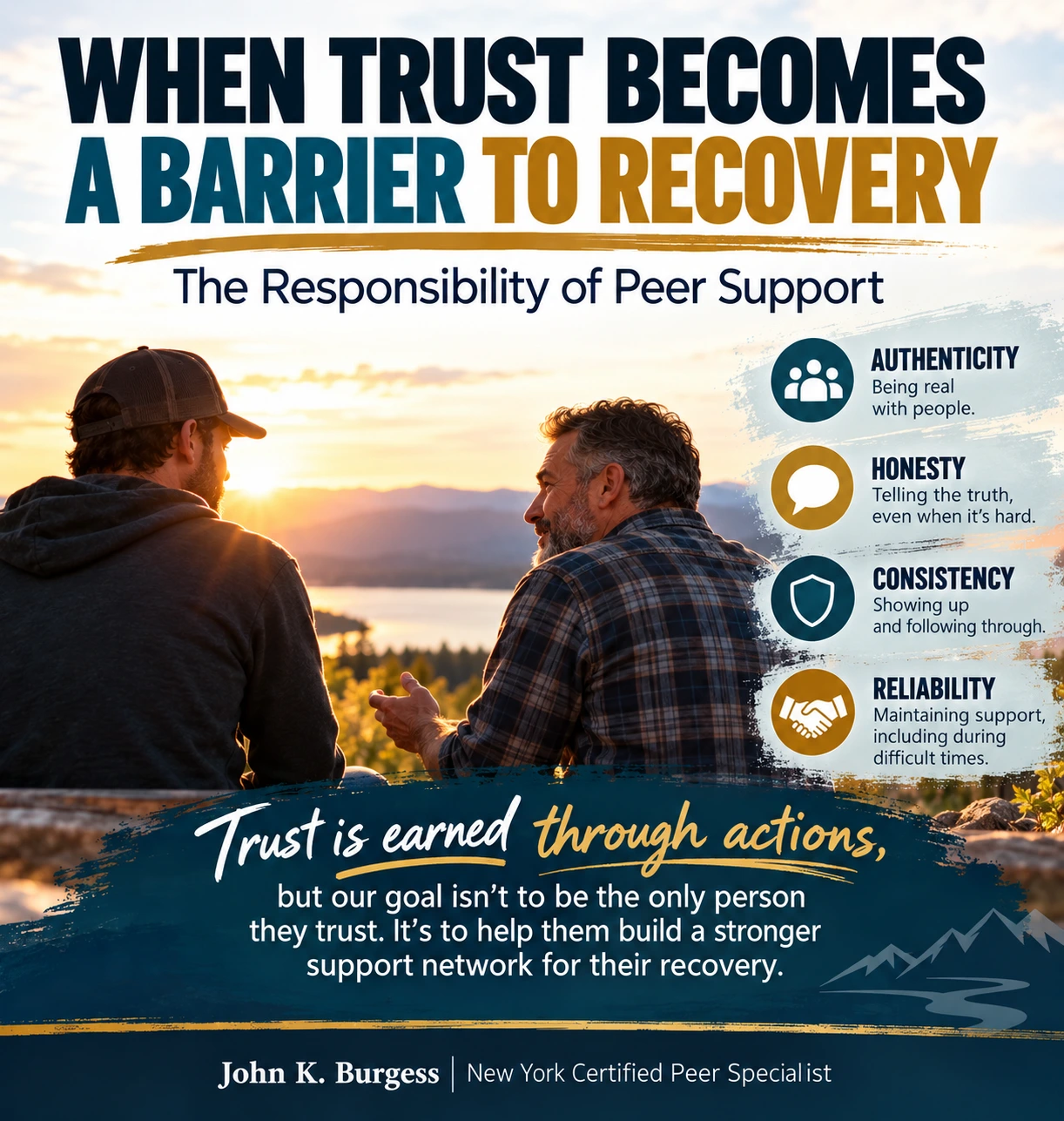
What happens when someone trusts their peer specialist but struggles to trust almost everyone else?
It’s a question that deserves considerably more attention within behavioral health, addiction recovery, and peer support.
As peer specialists, we work hard to establish meaningful relationships with the individuals we support. We demonstrate consistency. We listen without judgment. We respect personal boundaries. We share our lived experience when appropriate.
Over time, those relationships can develop into something incredibly valuable:
Trust.
But what happens when that trust exists almost exclusively within the peer relationship?
What happens when someone feels comfortable speaking openly with us but struggles to communicate with counselors, healthcare professionals, family members, other peers, or recovery supports?
At what point do we recognize that the trust we worked so hard to establish needs to become a bridge toward additional relationships?
Trust Is Earned, Not Demanded
One of the greatest mistakes we can make in behavioral health is assuming people should automatically trust us because of our professional titles, credentials, or good intentions.
Trust doesn’t work that way.
Someone who has experienced betrayal, abandonment, institutional mistreatment, broken promises, or other painful experiences may have very legitimate reasons for being cautious.
When someone tells us they don’t trust people, our first responsibility isn’t necessarily to convince them that they should.
Perhaps our first question should be:
“What would someone have to demonstrate before you considered them trustworthy?”
That changes the conversation.
Instead of treating mistrust as something that needs to be corrected, we begin exploring what trust actually means to that individual.
For some people, refusing to trust others may have once been an effective means of self-protection.
The difficulty arises when those protective behaviors begin preventing them from accessing the relationships, services, and opportunities they want for their recovery.
What Makes Someone Trustworthy?
This is where I believe peer support can offer something powerful.
Instead of asking someone why they don’t trust other people, perhaps we should ask why they trust us.
What did we do?
Were we authentic?
Were we honest, even when the conversation was difficult?
Were we consistent?
Did we show up when we said we would?
Did we listen without immediately trying to fix them?
Did we respect their right to make decisions we might not have made ourselves?
Did we continue offering support when their recovery became complicated?
Their answers can tell us something important about what they need from relationships.
Authenticity. Honesty. Consistency. Reliability.
Those qualities cannot simply be promised.
They have to be demonstrated.
The Hidden Challenge of Becoming the Trusted Peer
Being told that you are one of the few people someone trusts can feel like an extraordinary compliment.
But it also creates a significant professional responsibility.
We should appreciate that trust without allowing ourselves to become the center of someone’s recovery.
Our responsibility isn’t to become indispensable.
It’s to help individuals recognize their strengths, exercise self-determination, build confidence in their own judgment, and develop meaningful connections beyond our involvement.
If someone trusts only me, eventually I need to ask myself an uncomfortable question:
Am I helping this person expand their recovery support network, or have I unintentionally become their entire support network?
That isn’t always an easy question to answer.
But it’s an important one.
Authenticity Is Where Trust Begins
One of the most powerful lessons I’ve learned through peer support is that people don’t necessarily trust us because of our credentials, education, professional titles, or years of experience.
Sometimes they trust us because we’re real.
We’re honest with them.
We don’t tell them what they want to hear simply because it’s easier.
We remain consistent.
We respect their choices.
And our support doesn’t disappear simply because their recovery becomes difficult.
But there’s an important distinction between demonstrating unwavering support and becoming someone’s only source of support.
When someone trusts us because of our authenticity, we have an opportunity to help them recognize those same qualities in others.
Our goal shouldn’t be convincing people that everyone deserves their trust.
It should be helping them develop confidence in their own ability to recognize when someone has earned it.
Trust Doesn’t Have to Be All or Nothing
Trust exists on a continuum.
We don’t have to trust everyone with everything.
I can trust someone to help me with transportation without trusting them with my personal history.
I can trust a healthcare professional to provide medical information while still asking questions.
I can attend a recovery group without immediately sharing the most personal parts of my life.
I can have one conversation with someone without committing to an entire relationship.
This matters because someone who has experienced significant betrayal may view trust as an enormous decision:
Either I trust you or I don’t.
But there’s another possibility.
We can allow people to demonstrate trustworthiness gradually.
One interaction at a time.
One conversation at a time.
One commitment kept at a time.
And sometimes choosing not to trust someone is entirely appropriate.
Recovery should never require people to abandon their boundaries.
It should help people develop healthier and more effective ones.
Peer Support Should Build Bridges, Not Dependencies
This is where our responsibility becomes especially important.
One of the most valuable things we can offer someone is an experience of a relationship built upon mutual respect, honesty, authenticity, and consistency.
But that relationship should also create opportunities.
Perhaps we introduce someone to another peer specialist.
Perhaps we provide a warm handoff rather than simply handing them a telephone number.
Perhaps we accompany them to an unfamiliar appointment when appropriate.
Perhaps we help them prepare questions for a healthcare provider.
Or perhaps we simply help them recognize that the qualities they value in their relationship with us may exist in other people as well.
We shouldn’t rush this process.
And we certainly shouldn’t make developing additional relationships a condition of receiving our support.
The individual remains in control.
Our responsibility is to create opportunities, not requirements.
We Must Examine Ourselves, Too
There’s another side of this conversation that peer specialists need to discuss.
Being someone’s trusted person feels good.
Knowing that someone feels safe talking with us can reinforce our belief that we’re making a difference.
But we have to be careful.
Being needed and being effective are not necessarily the same thing.
We need to continually ask ourselves:
Am I encouraging independence?
Am I supporting relationships with other people?
Am I respecting this individual’s right to make decisions that differ from mine?
Am I maintaining appropriate boundaries?
And am I willing to recognize when my own emotional investment in a peer relationship might be influencing my approach?
Effective peer support requires that kind of self-examination.
Because our lived experience should create connection without creating dependency.
The Goal Isn’t Trusting Everyone
Perhaps we need to reconsider what success actually looks like.
The goal isn’t teaching someone to trust everyone.
That wouldn’t be healthy.
The goal is helping people develop the confidence to recognize trustworthiness.
To establish boundaries.
To communicate their needs.
To evaluate people according to their actions rather than their titles.
To recognize concerning behavior when it occurs.
And to understand that one person's betrayal doesn’t necessarily predict the behavior of everyone they will encounter in the future.
As peer specialists, we have an extraordinary opportunity to demonstrate what respectful relationships can look like.
But we also have a responsibility to recognize that our relationships are part of someone’s recovery journey.
We are not supposed to become the destination.
Sometimes one of the most meaningful things we can do is help someone discover that we’re not the only person they can trust.
Because successful peer support isn’t measured by how much someone needs us.
It is reflected, in part, in the confidence, choices, relationships, and connections they develop for themselves.
What do you think?
For those working in peer support, behavioral health, or recovery services: How do you support someone who trusts you but struggles to trust almost everyone else?
#PeerSupport #Recovery #MentalHealthRecovery #AddictionRecovery #PeerSpecialist #TraumaInformedCare #BehavioralHealth #RecoverySupport #LivedExperience #PersonCenteredCare